For most of design history, you had two options. You hired a designer. Or you figured it out yourself by flipping through magazines, walking showroom floors, buying things and returning them until the room started to look like something. Neither option was particularly efficient. One required a budget most people don't have. The other required time, confidence, and a tolerance for getting it wrong.
Then AI arrived and everyone assumed it would solve this. It did, but only part of it.
What AI Actually Changed
The thing AI genuinely did well was speed. You can describe a room, upload a few reference images, and receive a rendered concept in seconds. For someone who has spent years scrolling Pinterest with no clear direction, that kind of instant visualization felt like a breakthrough. And in some ways it was. AI made design feel less like an exclusive craft and more like something anyone could access. It lowered the activation energy to start.
But speed is not the same as clarity. And a beautiful render is not the same as a workable plan. The gap that opened up (and that almost nobody in the space has addressed directly) is the gap between what AI generates and what a real room requires. Your living room has a radiator in the wrong corner. A sofa you're not ready to replace. Ceilings that are too low for the light fixture that keeps appearing in every AI result. A landlord who won't let you paint.
AI, by itself, doesn't know any of that. It generates from an ideal, and most homes are not ideal.
The Two Failure Modes
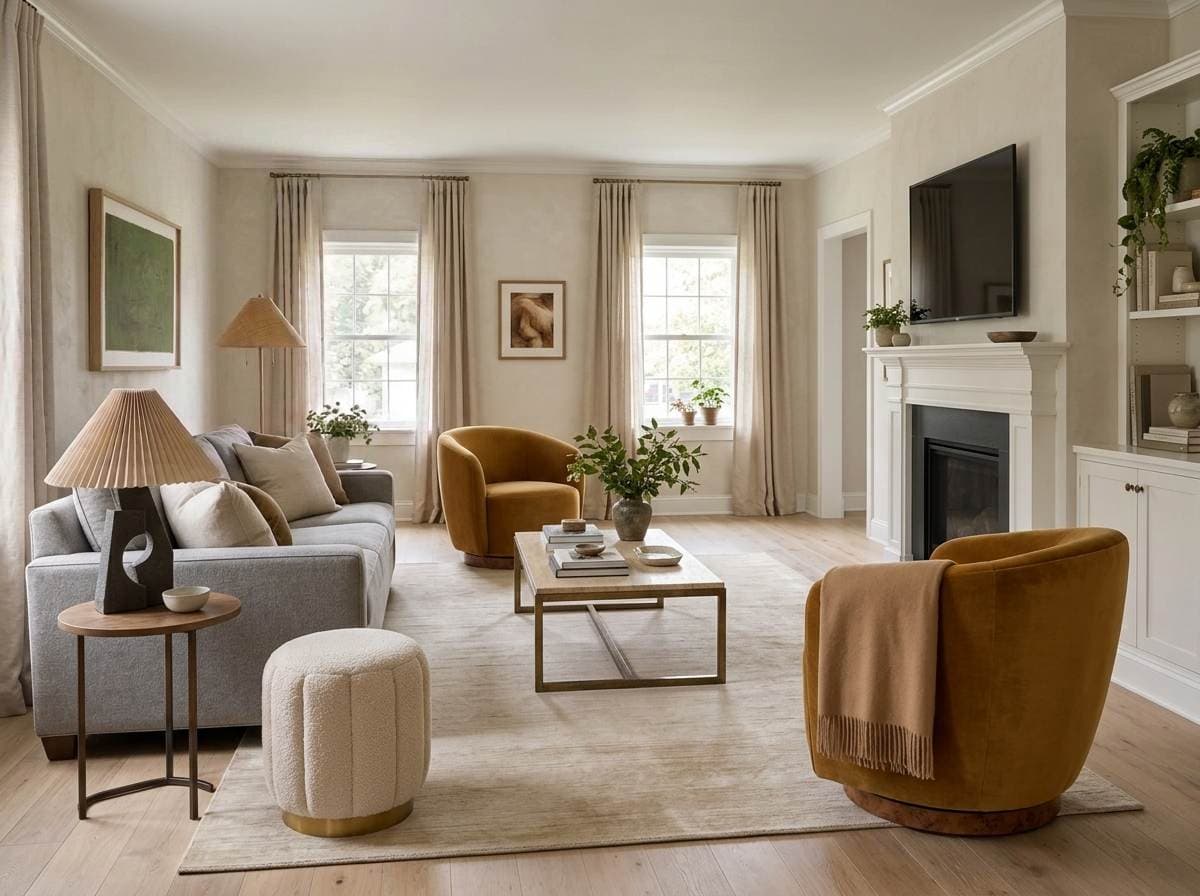
When people use AI design tools on their own, the results tend to fall into one of two categories. The first is the fantasy room: visually stunning, conceptually coherent, completely detached from reality. The furniture costs $40,000. The layout assumes a floor plan that doesn't exist. The light is perfect in the way that light is only perfect in renders. This version is inspiring in the same way a travel magazine is inspiring. You look at it, you feel something, and then you close the tab.
The second failure mode is more subtle, and maybe more frustrating: the generic room. Safe palette, predictable furniture arrangement, nothing technically wrong with it. It just doesn't feel like anyone in particular. It has the aesthetic signature of an algorithm that has seen too many rooms and averaged them together.
Both failures come from the same root cause: AI is very good at producing what looks like design, but it doesn't know you, your space, or what it actually means to live somewhere.
Where Designers Come In, A Bit Differently Than Before
This is not an argument against AI. It's an argument for what needs to sit alongside it. The role of the designer has always been to translate: between what a client says they want and what they actually need, between a concept and a buildable room, between taste and decision. That translation work is not something AI does intuitively. It requires judgment that comes from having stood in a lot of rooms, having made a lot of sourcing decisions, having learned which things look good in photos and which things hold up in person.
What's changed is where that designer expertise gets applied. In a traditional engagement, a designer spends a significant portion of their time on work that is now faster to do with AI: pulling reference images, generating initial concepts, exploring colorways, visualizing options. That work still has value, but it no longer requires hours of manual effort.
Which means a designer's attention can move earlier and later in the process. Earlier, into helping someone understand what they actually want before they start making expensive decisions. Later, into reviewing, editing, and grounding the AI-generated concepts in what's real, shoppable, and livable.
What This Looks Like in Practice
At Veyah Studio, we've built the platform around this model, not as a theoretical framework but as a practical workflow that a person can actually move through. In practice, it tends to follow a natural sequence.
- Discovery: getting clear on the feeling you want, the constraints that are non-negotiable and what the room needs to do. The Blueprint Style Quiz is where this starts.
- Design: pointing AI at that direction to generate options, test variations and surface products that fit the brief, in a photo of your own room with Room Edit.
- Refinement: a designer edits the result for budget, availability, fit and how it will actually live, which is what a Vibe Check is for.
The first phase is discovery, and it's the one most tools skip entirely. Most people who come to us have more inspiration than they know what to do with. The work isn't generating more ideas; it's developing a clear enough direction that the ideas they already have start to make sense. What's the actual feeling they're after? What constraints are non-negotiable? What's the room being asked to do? Getting honest answers to those questions shapes everything that follows.
From there, the design phase is where AI earns its place. Once there's a clear direction, AI can move quickly: generating options, exploring variations, surfacing products and references that fit the brief. That speed is genuinely useful when it's pointed at something specific. Without the discovery work up front, it mostly produces noise.
The third phase is refinement, and it's where the designer's eye matters most. The AI output gets edited, not just aesthetically, but practically. Is this product available and within budget? Does this layout actually work in the room as it exists? Is this choice something the person will still feel good about in three years? That review layer is what separates a workable plan from a render that looks good and goes nowhere.
The Broader Shift
Every technological shift in design has followed a similar pattern: the tools get faster, the volume of output increases, and the work changes shape around them. What's different this time is the nature of what we're handing off. Previous tools automated the physical: the drafting table gave way to CAD, the print mood board gave way to digital. But the process itself stayed human. AI is the first tool that reaches into the process: the ideation, the generation, the decision-making. Which makes judgment the thing that can't be automated. And that makes it more valuable than it's ever been.
That judgment is harder to define than it sounds. It's knowing which output is actually good, not just visually convincing. It's knowing when a direction is worth developing and when it's a dead end. It's understanding the difference between something that looks right in a render and something that holds up in a real room, in real light, lived in by a real person.
Designers have always done this work. What's changed is how much of the surrounding effort has been compressed. The hours that once went into generating options, pulling references, building out concepts, that time has been reclaimed. Which means the human contribution can go deeper, and further into the process, than it could before.
The result, when the collaboration works, isn't a room designed by AI or a room designed by a person. It's something more considered than either could produce alone, and far more likely to be somewhere you actually want to live in.
.png&w=1920&q=75&dpl=dpl_HsFNKev5vESE4Fpfsy7iSSi9PpFZ)