AI can redesign a room in seconds. But can it help you understand what’s actually wrong with the space you already have? That’s why we built What’s Off? inside Veyah Studio.
You can upload a photo of your living room to an AI interior design tool and ask it to make the space look better.
Chances are, you’ll get a beautiful image back.
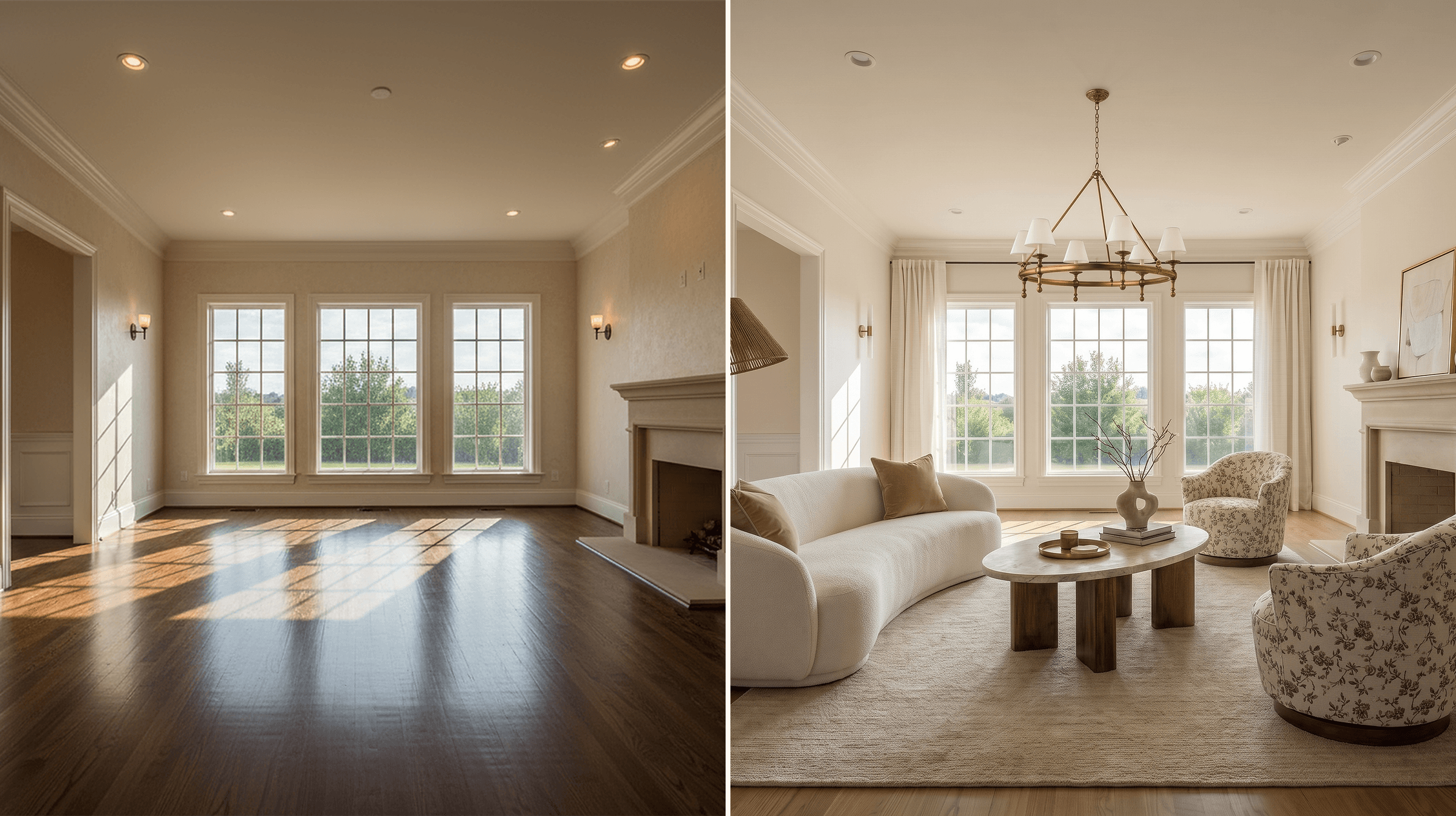
New furniture. Different colors. Perfectly styled shelves. Maybe a curved sofa you never asked for.
But what if you don’t want an entirely new room?
What if you like your furniture, you’ve spent time making the space your own, and something still doesn’t feel quite right?
That’s a different design problem. And it’s one that AI room makeovers don’t always address.
As an interior designer, I’ve spent years helping people figure out why a space isn’t working. Sometimes it’s the furniture arrangement. Sometimes it’s scale, lighting, or the relationship between individual pieces.
And sometimes the solution doesn’t involve buying anything new.
The process starts with understanding the problem, not immediately jumping to a redesign.
That’s the thinking behind What’s Off?, a feature we built into Veyah Studio’s Room Edit.
Why We Built What’s Off?
There’s no shortage of interior design inspiration.
Pinterest, Instagram, design blogs, and now AI image generators can show us almost endless possibilities for how a room could look.
But inspiration doesn’t necessarily tell us what to do with the space we already have.
You might know you want your living room to feel more cohesive, but not understand why it currently feels disconnected.
You might think your bedroom needs new furniture when the real issue is proportion or layout.
Or you might keep adding decorative accessories, hoping the room will eventually feel finished.
The challenge isn’t always a lack of ideas.
It’s not knowing which decision will actually improve the space.
We built What’s Off? to help bridge that gap.
Instead of beginning with a request to generate an entirely different room, What’s Off? starts by looking at what’s already there.
It uses AI room analysis to identify potential design issues, explain why they matter, and help you explore possible improvements.
The intention isn’t to replace an interior designer’s judgment with a list of decorating rules.
It’s to make that kind of design thinking more accessible.
What Does an AI Room Analyzer Actually Do?
An AI room analyzer examines a photograph of a space and identifies visual relationships that may be affecting the overall design.
Depending on the room and the information provided, it can recognize potential issues involving furniture scale, layout, visual balance, lighting, and proportion.
For example, a room might contain beautiful individual pieces that simply aren’t working together.
The sofa may be too far from the chairs for comfortable conversation. The rug might be too small to visually connect the furniture. Or the artwork may feel disconnected from the pieces beneath it.
These aren’t necessarily problems with the furniture itself.
They’re problems with how the room is arranged.
What’s Off? is designed to help identify those relationships and explain the reasoning behind its observations.
And because it lives inside Room Edit, the process doesn’t have to stop at a written recommendation.
You can continue exploring what a change might look like in your actual space.
Here’s What That Looks Like in a Real Living Room

Consider this living room.
At first glance, it’s a perfectly pleasant space.
There’s a neutral sofa, two upholstered armchairs, a coffee table, a patterned area rug, and plenty of natural light. The fireplace creates a focal point, and the room has enough furniture to feel established.
Nothing is dramatically wrong.
But the overall arrangement feels a little disconnected.
This is exactly the kind of room we had in mind when developing What’s Off?.
It’s not an empty space waiting to be furnished. It’s an existing room that could work better with a few thoughtful adjustments.
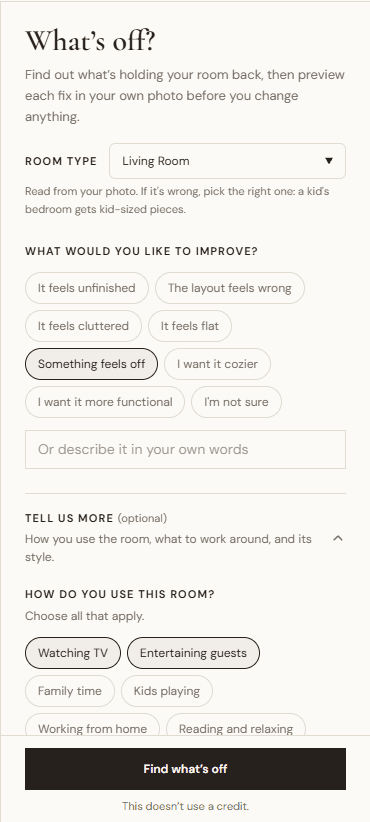
Using the room photograph and information about how the space is used, What’s Off? identified three areas worth examining.
1. The seating arrangement feels disconnected
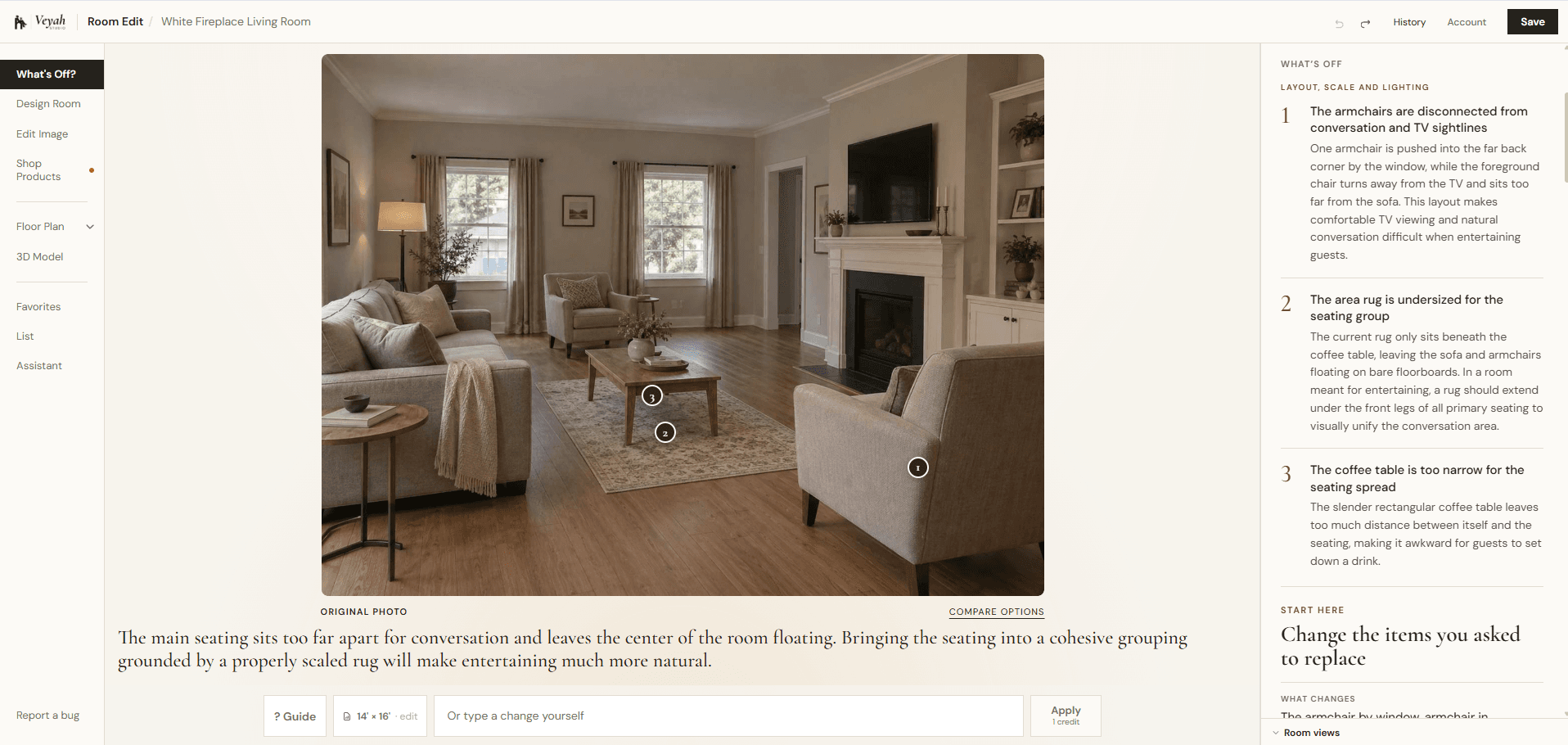
The first issue involved the placement of the armchairs.
Although the sofa and chairs occupied the same room, their positions didn’t create a particularly cohesive conversation area.
One chair was positioned away from the primary seating group, while the other didn’t relate naturally to the sofa or television.
From a design standpoint, the individual furniture pieces weren’t necessarily the problem.
Their arrangement was.
Bringing the chairs into a more intentional grouping could make the space feel more connected without requiring an entirely new set of furniture.
2. The rug isn’t anchoring the furniture
The second observation involved the area rug.
The rug was relatively small compared with the overall seating arrangement, leaving several pieces visually disconnected from one another.
A larger rug could help establish a clearer seating zone and create a stronger relationship between the sofa, chairs, and coffee table.
But the important consideration isn’t simply buying a bigger rug.
It’s understanding how the rug should relate to the furniture arrangement.
If that arrangement changes, the ideal rug dimensions may change too.
3. The coffee table doesn’t quite fit the seating group
The third issue involved the coffee table’s proportions.
Its relatively narrow size, combined with the distance between the seating pieces, made the arrangement feel less functional and cohesive.
A larger table might help, but it wouldn’t necessarily be our first recommendation.
Before replacing anything, we’d want to consider whether adjusting the chairs would improve the relationship between the existing pieces.
This is an important part of the design process.
Identifying a problem doesn’t automatically mean replacing the object associated with it.
Sometimes the issue is how everything works together.
The Most Important Part Isn’t the List of Problems
Here’s what makes this example interesting.
The AI identified three separate concerns: disconnected seating, an undersized rug, and an awkwardly proportioned coffee table.
But those concerns are related.
The room’s underlying issue is the relationship between the furniture pieces.
Moving the chairs could improve the conversation area and change how the coffee table functions.
Reconsidering the furniture arrangement could also influence what rug size makes sense.
These decisions shouldn’t happen independently.
As designers, we look at how individual choices affect the entire space. A small adjustment in one area can change what needs to happen somewhere else.
That’s the kind of thinking we want What’s Off? to support.
Not an endless list of things to buy or replace, but a clearer understanding of what may be causing the problem and where to begin.
From Understanding the Problem to Seeing a Possible Solution
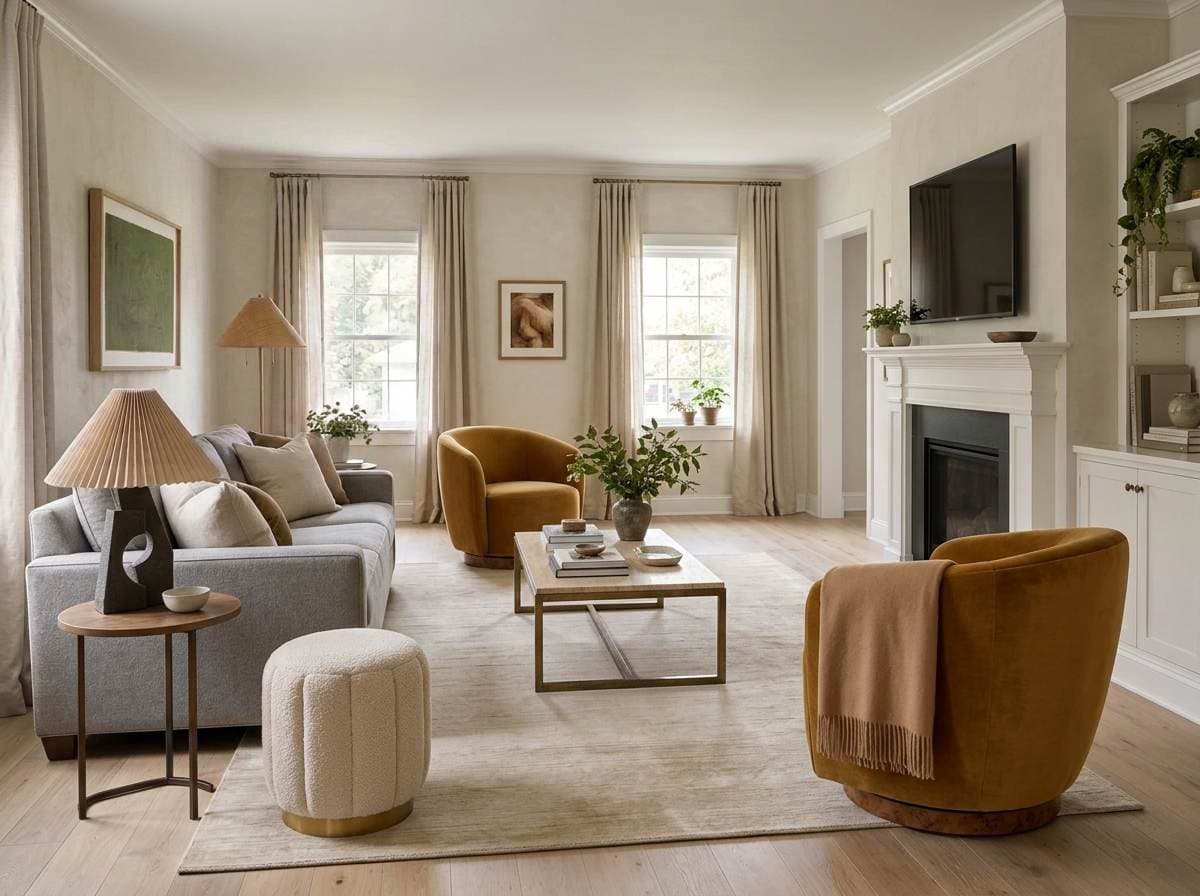
Once you’ve identified what might not be working, the next challenge is imagining how the room could improve.
That’s where Room Edit comes in.
With the living room example, we explored an updated arrangement and design direction.
The resulting visualization included a larger rug, a revised seating group, a differently proportioned coffee table, and additional changes to the room’s finishes and styling.
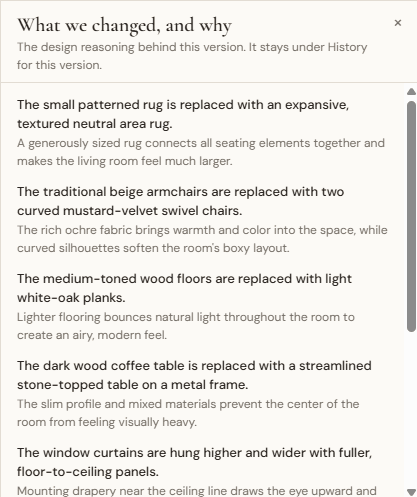
The new image felt more visually connected.
The larger rug helped define the seating area. The updated chairs introduced a different furniture silhouette and warmer accent color. Changes to the lighting, curtains, and accessories created a more layered interior.
But here’s an important distinction.
Just because AI can change something doesn’t mean it needs to be changed.
The original flooring wasn’t necessarily a problem. The existing armchairs weren’t inherently wrong. And a more dramatically styled room isn’t automatically a better room for the people living in it.
The visualization represents one possible direction, not a mandatory shopping list.
That’s why we believe the process should begin with understanding what needs attention.
Once you know the problem you’re trying to solve, you can evaluate potential changes more intentionally.
Maybe a larger rug makes sense. Maybe the chairs can stay but need to move. Maybe you love the original coffee table and want to design around it.
The final decision should still be yours.
Can AI Room Analysis Replace an Interior Designer?
Not entirely. And that’s not what we’re trying to accomplish.
AI can identify visual patterns, recognize certain spatial relationships, and offer useful suggestions based on the information it’s given.
But a photograph only tells part of the story.
It doesn’t reveal how comfortable your sofa is, what the room feels like at night, or how your family moves through the space throughout the day.
It may not know that a particular chair belonged to your grandmother, that the afternoon sunlight creates glare, or that replacing the rug simply isn’t in the budget.
A photograph also can’t reliably establish every dimension, clearance, or condition needed to make a final design decision.
And not every unconventional design choice is a mistake.
A collected, eclectic room might intentionally have mismatched furniture and layered patterns. A minimalist room might use negative space in ways that appear unfinished to someone unfamiliar with the intended design.
Good design isn’t about making every room follow the same formula.
It’s about understanding the intention behind the space and making choices that support it.
That’s where professional judgment remains valuable.
Veyah combines AI tools with access to real designer feedback through services like Designer Check and Vibe Check.
The AI can help identify possibilities and explore changes. A designer can help evaluate those options with a deeper understanding of how a space should function and feel.
We see those as complementary parts of the process, not competing approaches.
A Better Way to Use AI for Interior Design
The most useful question you can ask an AI interior design tool isn’t always, "Can you make this room look better?"
Sometimes it’s:
- —"Why doesn’t this arrangement work?"
- —"Is the furniture the wrong size, or is it just in the wrong place?"
- —"What’s the one change that would make the biggest difference?"
- —"Can I improve this room without replacing everything?"
Those questions lead to a more thoughtful design process.
Instead of starting over every time something doesn’t feel right, you can begin to understand the decisions behind a successful space.
That’s ultimately what we’re building toward with Veyah Studio.
Tools that help people move beyond collecting inspiration and generating attractive images, toward understanding their spaces and making more confident decisions.
So, Can AI Tell You What’s Wrong With Your Room?
Yes, with some important limitations.
AI room analysis can help identify potential issues with layout, scale, proportion, and visual balance. It can recognize relationships you might have overlooked and explain why those relationships could be affecting the room.
But identifying something that could change isn’t the same as deciding what should change.
And a beautiful AI-generated image isn’t proof that every suggested improvement is necessary.
That’s why we built What’s Off? around a different starting point.
Before asking what your room could become, we want to help you understand what’s already there.
Because sometimes you don’t need a new sofa, a different color palette, or another round of inspiration.
You just need to know what to do next.